
Digital Business Cards for Sales Reps: Fewer Steps Between Meeting and Follow-Up
Most of a sales week goes to everything but selling. A business card in your Apple or Google Wallet costs none of that time, and one scan shares your details.
Everyone on your calendar invite already has your email. A business card is for the others: the colleague your buyer pulls into the room at the end, the person at the next booth, the contact you meet in the corridor on the way out. Nobody sent them your details in advance, and none of them will spell your surname correctly from memory. In this guide I'll show you what a digital business card changes in a sales week, how you share it in a customer meeting, and what happens when your title or your number moves on.
Key Takeaways
- The average seller spends only 40% of their working time actually selling (Salesforce, 2026). A business card shouldn't eat into the rest.
- Your card sits in Apple Wallet or Google Wallet, so it's ready whenever your phone is. Nothing runs out, nothing needs reprinting.
- Your prospect scans your QR code with their normal camera. No app on their side, no signup, and no signal required.
- Pick the Editable Card when your title, your number, or your territory is likely to change. The pass then updates itself in your Apple or Google Wallet.
What does a sales rep need from a business card?
Four things: it has to be with you at every meeting, it has to be current, nobody should need to install anything to receive it, and it has to work with no signal. Paper fails the first two. A card that lives inside an app clears the third. But it keeps your own card behind a login, and it usually needs a connection at the other end.
Paper's real problem is not the paper. Back in 2016, Adobe reported that 88% of business cards handed out are thrown away within a week. And 63% of them go because the recipient didn't need the service at that moment (Adobe, 2016).
That second number is the one worth sitting with as a rep. Your card usually isn't rejected on merit. It's rejected on timing. So the job of the card isn't to be kept on a desk. Its job is to put your details in the address book your buyer searches four months later, when the need finally shows up. A contact saved in a phone is still there in month four. A card in a jacket pocket went through the wash in week one. The broader shift behind that is in our digital business card statistics.
Why doesn't another sales app help here?
Because the week is already full. Salesforce's 2026 State of Sales report, a survey of 4,050 sales professionals, found the average seller spends 40% of their time selling. Gen Z reps sit at 35%, losing around two hours a week to manual data entry alone (Salesforce, February 2026).
Where the selling week goes
Share of working time spent actively selling
Average seller
40%
Gen Z reps
35%
Selling
Everything else
Source: Salesforce, State of Sales (seventh edition), February 2026. Survey of 4,050 sales professionals.
Anything you add to that week has to earn its place. A card built around an app asks you to install it, keep a profile in sync and remember your password. A card in your wallet asks for none of that. You create it once in a browser, save it to Apple Wallet or Google Wallet, and from then on it sits with your boarding passes and your parking tickets.
A digital wallet is hardly exotic technology by now. Juniper Research counted around 4.4 billion wallet users in 2025 and expects more than 6 billion by 2030 (Juniper Research, 2025). The full case for skipping the download is in our guide to the digital business card without an app.
How do you share your card in a customer meeting?
You open the pass in your Apple or Google Wallet, your QR code appears on the card, and your prospect scans it with their normal camera app. Their phone offers to save the contact, they tap once, and your name, mobile number and email land in their address book spelled correctly. No dictation, no typos in your surname.
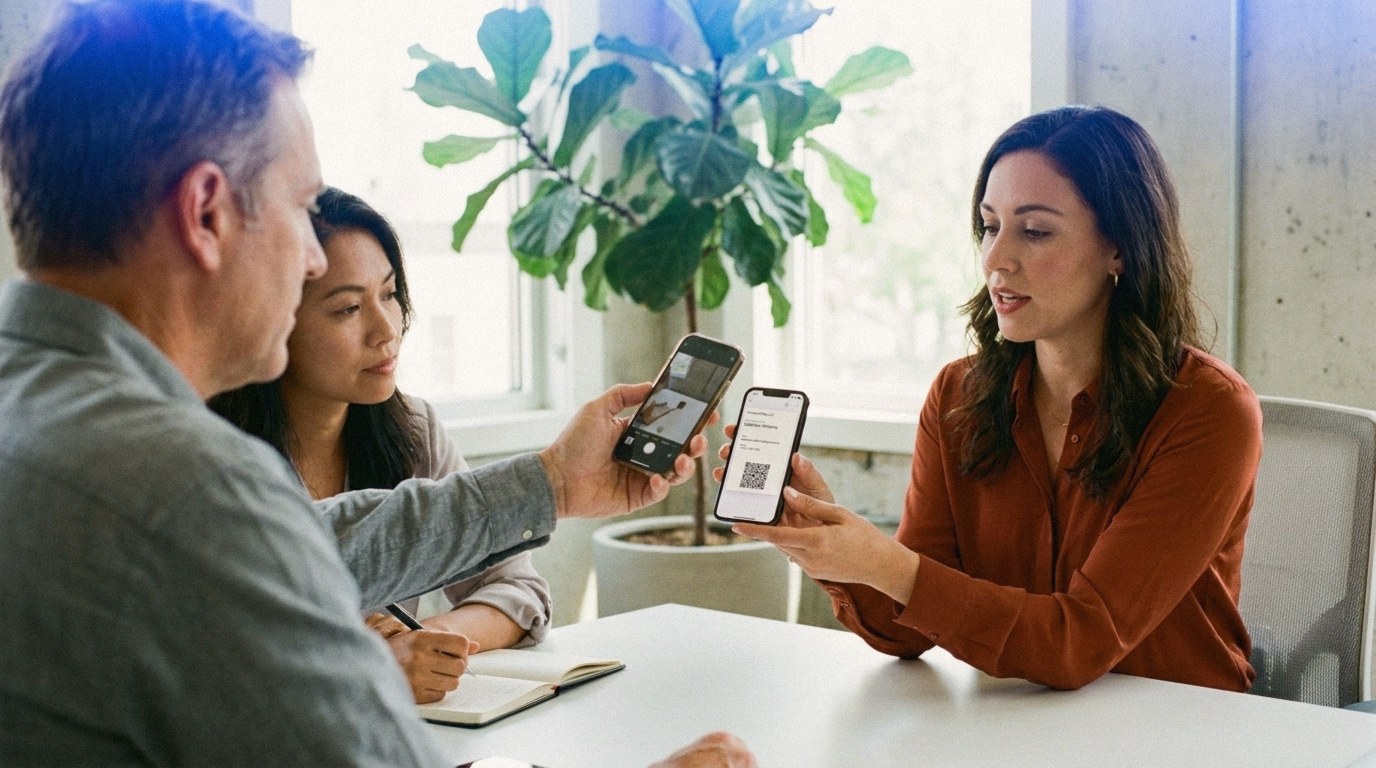
Nobody needs coaching for this part. Statista counted more than 100 million US smartphone users scanning QR codes in 2025 (Statista, 2025). Your buyer scanned a menu, a parcel label or a payment code this week already.
My tip from practice: when a new face joins the room, share your card there and then, not in the doorway on the way out. It takes two taps, and at the table it reads as part of the conversation instead of a goodbye ritual. If you want the whole setup first, the step-by-step is in how to create a digital business card.
What happens when your title or your number changes?
That depends on which variant you picked. A fixed card stays exactly as you created it. You can change both the details and design of an Editable Card anytime. The pass then refreshes itself in Apple Wallet and Google Wallet without you sending anyone anything.
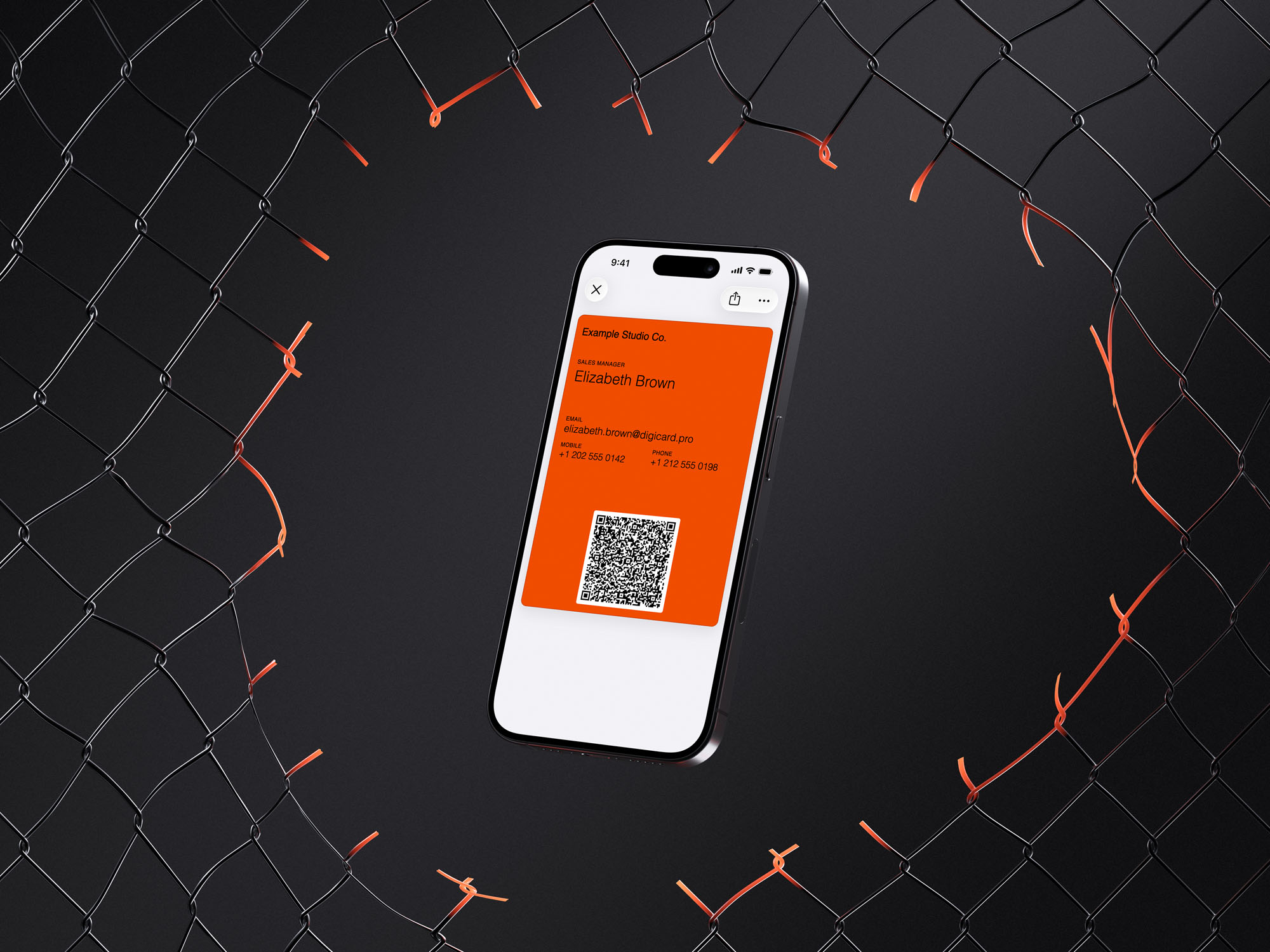
Sales titles move after a good year. Numbers move after a new phone or a switch to another territory. With printed cards, each of those changes leaves you with a box you can't use and a pile you keep handing out anyway. With the Editable Card, you change the detail once and the card is correct at your next meeting. Your contact details are re-encoded in the QR code, and the pass updates in place. How that looks on each platform is covered in the guide to the wallet business card and, for iPhone users, the Apple Wallet business card.
Does it work at a trade fair with no signal?
Yes, and this is where a lot of tools quietly fail. Your contact details sit inside the QR code itself, not on a server the scan has to reach. So neither phone needs a connection. In a packed hall where the network buckles by mid-morning, that is the difference between sharing your details and promising to email them later.

Event days are also the days you run out. A stack of cards that looked generous on Monday is gone by the second afternoon, usually right before the conversation you actually wanted. A card in your wallet has no quantity to run down. And if you're reading this two days before a fair, the fastest routes are in last-minute business cards.
How do you equip a small sales team?
One card per person, built on a shared design so the team looks like a team. You can prepare a reusable template in the browser and create each rep's card from it, which keeps colors, company name and job titles consistent without anyone opening a design file. Use an account when you need central group management. When email-link editing is enabled, employees whose cards contain their email address can update them individually through the edit page.
That distinction is worth knowing before you start. Managed groups live in your account: shared defaults, fields you lock so nobody overwrites the company name, and a bulk import that reads a spreadsheet of names. Equipping four reps? The browser template is enough. Equipping forty? Use the group.
New hires are the clearest win. There's no print run, no minimum order and no waiting for delivery, so somebody who starts on Monday can share their details in their first customer meeting on Tuesday. Colleagues who work alone will recognize a lot of this from our guide for freelancers, and field-heavy roles from the one for real estate agents.
Your next meeting is already in the calendar. Build your card in the card generator, save it to your Apple or Google Wallet, and walk in with your details one scan away.
Common questions from sales teams
What does a digital business card cost for a sales rep?
With DigiCard Pro it's a one-time payment per card, with no subscription and no seat fees. You build the card in the card generator, see a live preview while you type, and the passes for Apple Wallet and Google Wallet are both included.
Does my prospect need an app to receive my card?
No, and that matters more in sales than anywhere else. Nobody installs an app in the middle of a meeting. Your prospect points their normal camera at your QR code, taps the preview, and your details are saved in their address book.
What if my prospect uses Android and I use an iPhone?
It makes no difference. Every card comes with a pass for Apple Wallet and one for Google Wallet, and the scan happens through the camera app either way. Your prospect never has to match your platform. If you're the one on Android, the setup is in the guide to the digital business card for Android.
Can I see who scanned my card?
No. Your contact details sit directly in the QR code rather than behind a tracking link, so nothing reports a scan back to you. That keeps the card offline-capable, and it leaves lead tracking where it belongs, in your CRM. If all you need is a plain QR code image, the free QR code business card explains that route.